
Reviewed · COCOA AND CHOCOLATE FARM TOURS
Basel: Farmer’s Market, Cheese, Chocolate & Pastry Tour
Basel serves up a fine first taste of Switzerland here: cheese, chocolate, and Lackerli pastry folded into a short walk through the Old Town. You’ll see the Town Hall, Basel Minster, Tinguely Fountain, and market streets while a private guide explains how local food connects to the city.
I like the easy mix of sightseeing and sampling, and I like that the cheese portion can go beyond the usual Gruyère to include Sbrinz, Appenzeller, Raclette, and Tête de. The main caution is value: at $194 per person for two hours, you’ll want a guide who truly walks and explains Basel, not one who turns the outing into a sales stop.
Key points at a glance
- Basel landmarks first: Begin at the Town Hall and see Basel Minster, the Altstadt Grossbasel, and Tinguely Fountain.
- A serious cheese tasting: Sample several Swiss cheeses, including Gruyère AOP, Sbrinz, Appenzeller, Raclette, and Tête de.
- Chocolate with context: Learn how Switzerland built its chocolate reputation, then taste items such as truffles, dark chocolate, or chocolate almonds.
- A local pastry finish: Try Lackerli, Basel’s traditional spice biscuit with roots reaching back to the 17th century.
- Private English-speaking guide: Guides named Gina, Jean, and Jonas have led this experience at different times.
- Worth checking before booking: The advertised schedule appears to describe more time than the stated two-hour duration, so confirm the exact route and tasting stops.
Starting at Basel Town Hall
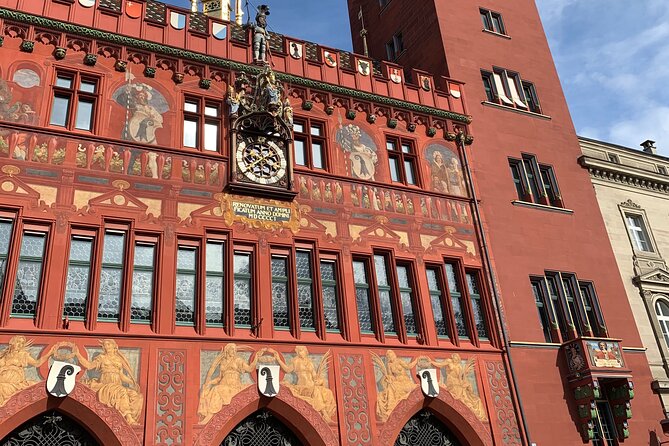
Your meeting point is inside the main courtyard of Basel Town Hall, beside the Roman statue. That is a practical place to begin because the red sandstone building puts you right in the historic center, rather than on the edge of town.
The Town Hall is more than a meeting landmark. Its age, paintings, and civic setting help frame Basel as a city where public life, art, and commerce have long shared the same streets. You will return here at the end, so the location also makes it easy to continue exploring on your own.
Look for the guide inside the courtyard, not simply outside the building. That small detail matters in a busy city center, especially if you arrive early and see several entrances.
The tour is private, which gives you more room to ask questions and set the pace. It also means the quality depends heavily on the individual guide. Gina, Jean, and Jonas are names connected with this experience, and the strongest feedback specifically praises their friendly manner, clear explanations, and patience while people shop.
More Cocoa Farm Tours in the world:
- Lahaina: Maui Ku’ia Estate Guided Cacao Farm Tour and Tasting
★ 5.0 · 1,103 reviews - Kauai Chocolate Farm Tasting Tour
★ 5.0 · 666 reviews - Award Winning Farm Tour: Coffee, Chocolate and Unique Gifts
★ 5.0 · 484 reviews
Basel Minster and the city’s old center
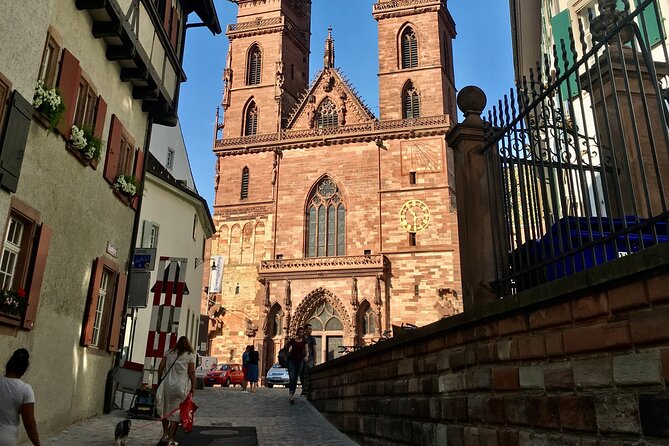
The walk continues toward Basel Minster, one of the city’s key landmarks. The Minster visit is listed as a guided portion of about an hour, although the overall tour is advertised at two hours. That makes it worth confirming how the guide divides time between the church, other sights, and food stops.
The Minster gives the tour a useful historical anchor before the tastings begin. Rather than treating food as a separate shopping activity, the route links local specialties with the buildings and streets that shaped Basel.
From there, you move through Altstadt Grossbasel. This is the part of the tour meant to help you get your bearings. You’ll see old buildings, cultural landmarks, and city details that are easy to pass if you are walking without a guide.
The route also includes the Tinguely Fountain, an unusual and memorable modern artwork. Its moving forms offer a sharp change from the older architecture around it. That contrast is one of Basel’s pleasures: medieval and civic buildings sit close to modern art and contemporary city life.
The food portion takes place during this Old Town walk, with a visit to a local market or food shop. The exact order may vary, but the experience is designed to move between sights and tastings rather than save every sample for one final stop.
The cheese tasting: from Gruyère AOP to Basel specialties
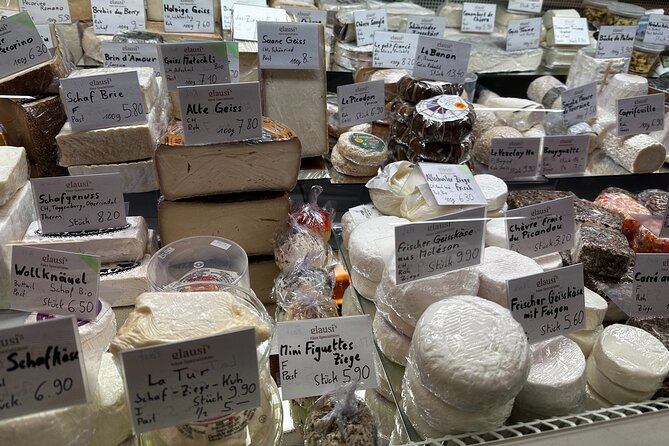
Cheese is the most detailed food section of the experience. You are introduced to several Swiss varieties and given a chance to compare mild and stronger flavors, younger and more aged pieces.
The listed selection includes:
- Gruyère AOP
- Sbrinz
- Appenzeller
- Raclette
- Tête de
- Other Basel cheeses
Gruyère AOP is perhaps the familiar name, but the broader selection is what gives this tasting its value. AOP means the product follows protected standards tied to its place and method of production. That does not automatically make every cheese your favorite, but it gives you a useful way to understand why Swiss cheeses taste and feel different from one another.
You may also learn about cheese aging from a cheese specialist and master ager. This is a good part of the tour to slow down and ask questions. Aging changes firmness, aroma, saltiness, and finish, so tasting several cheeses side by side can teach you more than buying one wedge at a shop.
The experience also emphasizes cheese made without preservatives, artificial coloring, or flavor enhancers. That is an appealing point for anyone interested in traditional production, though the tour’s real strength is being able to taste the difference between varieties rather than simply hearing a list of ingredients.
Here is where the private format helps. If you already know your way around cheese, ask about age, milk, texture, or how each variety is normally served. If you are new to Swiss cheese, ask the guide to start with the mildest sample and work upward.
There is one important value question. The tour may bring you to a business connected with the guide or provider. That is not necessarily a problem, especially if the cheese explanation is detailed and the tasting is generous. But you should know the difference between an educational tasting and a shop visit. One past experience felt heavily focused on standing at a counter and being sold cheese, with very little city touring. The tour is far better suited to you if the guide keeps the cultural walk central.
Swiss chocolate, with a look at how it developed
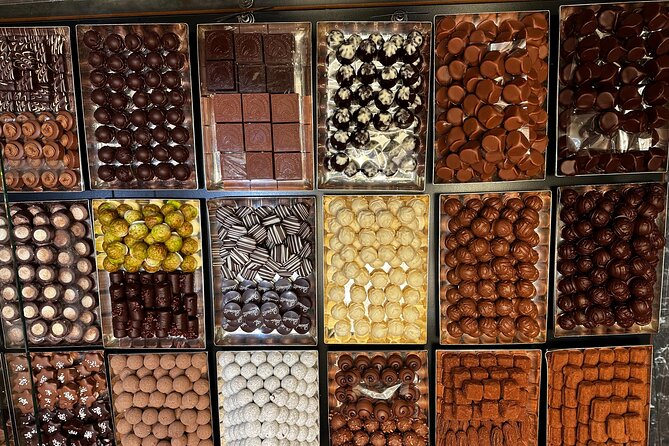
Chocolate is the other main tasting stop. The guide explains the development of the Swiss chocolate industry and why Switzerland became associated with high-quality chocolate around the world.
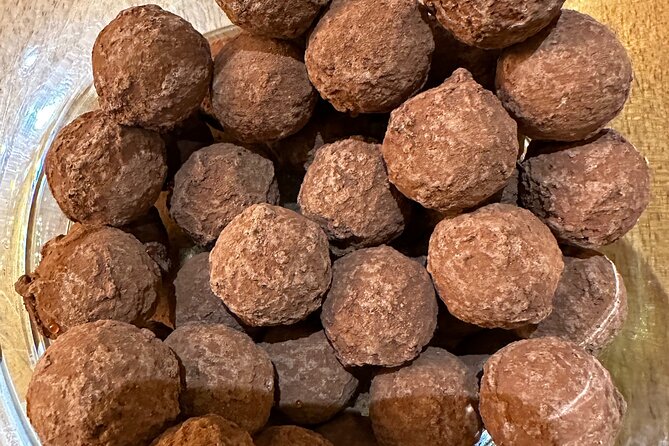
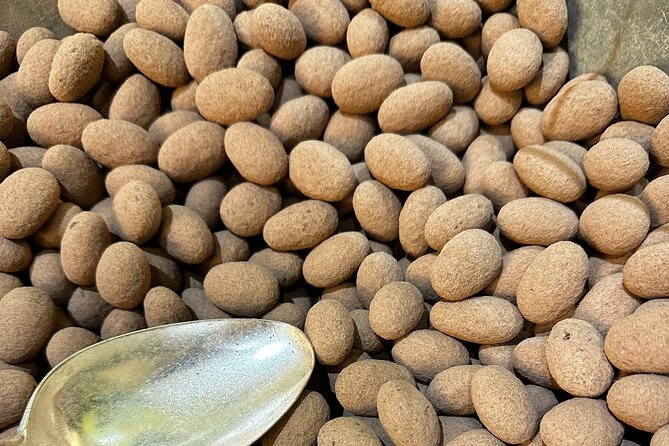
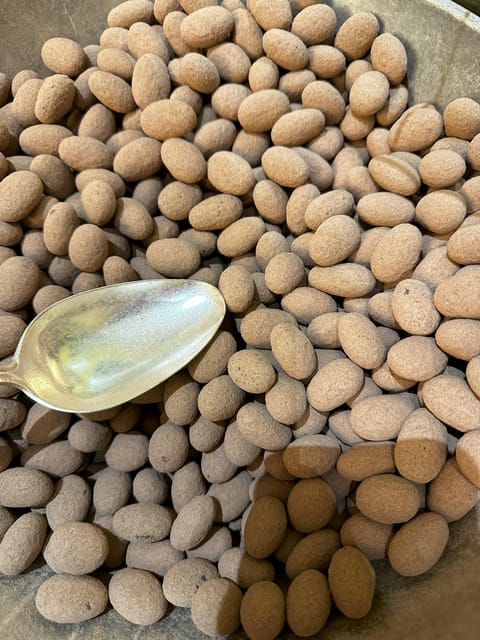
You may taste truffles, hand-scooped dark chocolate, chocolate almonds, chocolate beans, or pieces from chocolate bars. The exact choices can vary, but the focus is on freshly made chocolate without additives.
I like this part best when you treat it as a lesson in taste rather than a hunt for the largest sample. Dark chocolate, almonds, truffles, and chocolate beans have very different textures. Small portions are enough to compare them, especially after the cheese tasting.
The chocolate stop also gives you a chance to buy something for later. One useful tip is to leave room in your bag and your appetite. People have enjoyed shopping during the tour, and one guide, Jean, was specifically praised for being patient while a group decided what to take home.
Still, be clear about what you are paying for. This is not a long chocolate-making workshop, and the available information does not promise that you will make chocolate yourself. You learn about the industry and production, then taste finished specialties.
If you want a hands-on class, this is not the right format. If you want a compact introduction to Swiss chocolate while walking around Basel, it fits better.
More Cheese Farm Tours in the world:
- Authentic Farm Tour with Pizza, Cheese, Wine & Limoncello Tasting
★ 5.0 · 698 reviews - Sorrento Farm by Tuk Tuk: Cheese, Limoncello & Hands-On Pizza
★ 5.0 · 628 reviews - Sorrento: Farm Tour with Cheese Tasting & Pizza Making Class
★ 5.0 · 503 reviews - Amsterdam: Experience Zaanse Schans Windmills & Cheese Farm
★ 4.1 · 354 reviews
Lackerli, Basel’s spice biscuit
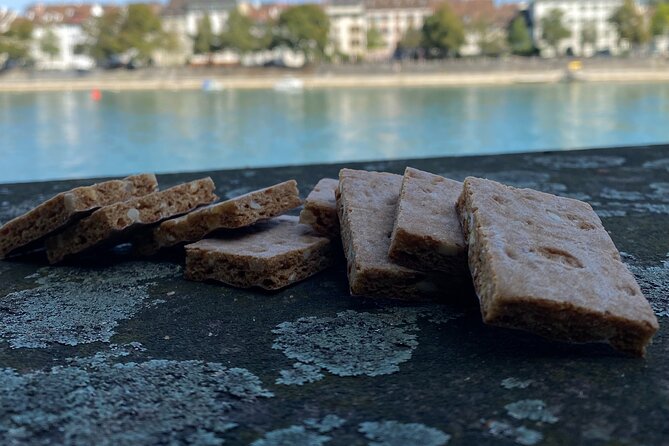
The final food stop is a local bakery or sweet shop for Lackerli, also spelled Läckerli in some references. The supplied tour information calls it a traditional Swiss spice biscuit and refers to it as a 17th-century pastry.
Lackerli is associated especially with Basel, which makes it a more local finish than another generic chocolate sample. Its flavor is shaped by spices, and its recipe was traditionally passed along through handwritten or spoken instructions. The story of the pastry also points to ordinary household production, when women made it at home as an extra source of income.
That background gives the tasting a human scale. Cheese and chocolate are national symbols, but Lackerli tells you something more specific about Basel’s food culture.
The bakery visit may be quick. In one reported experience, the guide helped choose pastries from a shop window and brought them back in a bag rather than leading a full bakery visit. If you want time to browse, ask your guide how much time is planned before the stop.
You should also expect a tasting, not a pastry class. The value comes from trying a local specialty and learning why it matters, not from watching a baker prepare it.
How the two-hour schedule really works
The advertised duration is two hours, with a start and finish at Basel Town Hall. It is a walking experience, and the route combines a guided visit to Basel Minster with Old Town sightseeing, market time, and tastings.
One practical issue deserves attention: the stated itinerary lists one hour at Basel Minster and 100 minutes in Altstadt Grossbasel, yet the total duration is only two hours. Those figures appear to overlap or describe approximate route segments. Ask at booking how much time is actually reserved for each tasting and landmark.
That question matters because food tours can feel very different depending on the balance. A two-hour walk with brief samples can be a useful city introduction. Two hours spent mainly at one counter offers much less sightseeing for the same price.
The tour is conducted in English and is described as wheelchair accessible. Since the route includes historic city streets and several stops, it is sensible to confirm the exact path and access arrangements if you use a wheelchair.
No separate transportation is listed. Plan on walking from the Town Hall through the Old Town and back. The return to the same central point is convenient for continuing to Basel Minster, shopping, or finding lunch afterward.
What $194 per person buys you
At $194 per person, this is a premium short tour. The price makes the most sense for a private group that values a personal guide, a compact orientation to Basel, and a set of tastings without arranging each stop yourself.
For a couple or small family, the private format can be worthwhile. You can ask more questions, adjust the pace, and get recommendations suited to your interests. The guide also helps connect the food with the city, which is harder to do when you simply visit a cheese shop and chocolate store on your own.
For a larger private group, the price may feel easier to justify if the guide provides substantial explanations and the tastings are well chosen. A group of seven has enjoyed the format, especially when the guide allowed time for shopping.
The price feels less attractive if the experience consists mainly of a shop counter, small samples, and a pastry handed over in a bag. Before paying, ask for a clear description of the walking route, the number of food stops, and whether the guide will enter the landmarks or explain them from outside.
Free cancellation up to 24 hours before the tour and the option to reserve now and pay later reduce some booking risk. Those policies are useful, but they do not change the central value question: you are paying for private guiding and interpretation, not only for food.
Who will enjoy this Basel food walk?
I would recommend it most to someone arriving in Basel for the first time and wanting a fast introduction to both the city and Swiss specialties. The combination of Town Hall, Minster, Tinguely Fountain, cheese, chocolate, and Lackerli gives you several useful starting points for the rest of your stay.
It also suits families and mixed-interest groups. One person can focus on art and architecture while another asks about cheese or chocolate. The private setting is more flexible than a large scheduled group.
It is a good match for you if:
- You want a private guide rather than a self-guided food crawl.
- You enjoy tastings but also want city landmarks.
- You are curious about Swiss cheese aging and AOP production.
- You want to try Basel’s Lackerli pastry.
- You prefer an English-language tour.
- You like having time to buy food to take home.
I would be cautious if you want a long cultural tour, a full meal, or hands-on chocolate making. The experience is short, and the quality depends on how much your guide walks and explains instead of keeping you at a shop.
Should you book the Basel cheese and chocolate tour?
Book it if you want a private, food-centered introduction to Basel and you value a guide who can connect local landmarks with Swiss eating traditions. The best version of this tour gives you a clear look at the Old Town, useful context at the Minster and Tinguely Fountain, and thoughtful tastings of cheese, chocolate, and Lackerli.
Before booking, confirm the exact timing and ask how the food stops are handled. That simple check can help you avoid the main disappointment: paying a high price for what feels like a sales visit.
If the operator confirms a real walking route with substantial guiding, the tour can be a pleasant way to get your bearings and discover what to eat next. If you mainly want to sample chocolate and cheese at the lowest cost, you can likely spend less by visiting shops on your own.
FAQ
Where does the tour begin?
The meeting point is inside the main courtyard of Basel Town Hall, next to the Roman statue.
Where does the tour end?
The tour returns to Basel Town Hall.
How long does the experience last?
The advertised duration is two hours.
What language is the tour offered in?
The live tour guide speaks English.
Is this a private tour?
Yes. The activity is organized for a private group.
What foods are included?
The experience includes Swiss cheese, chocolate, and a local specialty tasting. The pastry stop features Lackerli, a traditional Swiss spice biscuit.
Which Swiss cheeses might I taste?
The listed cheeses include Gruyère AOP, Sbrinz, Appenzeller, Raclette, Tête de, and other Basel cheeses.
Is the tour wheelchair accessible?
Yes. The activity is described as wheelchair accessible.
More Market Tours in the world
- Cooking Class and Lunch at a Tuscan Farmhouse with Local Market Tour from Florence
★ 5.0 · 4,831 reviews - Chiang Mai: Authentic Cooking Class with Market & Farm Visit
★ 4.9 · 4,546 reviews - Floating & Railway Market and Coconut Farm Tour [Optional Luxury]
★ 5.0 · 835 reviews - Evening Cooking Class in Organic Farm with Local Market Tour
★ 5.0 · 394 reviews
Just added around the world
- Zanzibar: Walking Spice Farm with Local Cooking Class★ 4.4 · 9 reviews
- Zanzibar:Jozani forest, Spice farm with Swahili Cuisine clas★ 4.2 · 3 reviews
- ZANZIBAR, Stone town tour, Prison Island & Spice farm★ 5.0 · 11 reviews
- Zanzibar: Spice Farm Tour with Traditional Cooking Class★ 4.6 · 16 reviews
- Zanzibar: Stone Town City Tour and Spice Farm with Lunch★ 3.7 · 33 reviews
- Zanzibar: Spice farm tour with Zanzibar fruits tasting★ 3.8 · 7 reviews
- Zanzibar: Spice Farm Tour with Cooking lesson★ 4.5 · 4 reviews
- Zanzibar: Spice Farm Tour with Traditional Cooking Class★ 4.8 · 6 reviews
Cocoa and Chocolate Farm Tours, compared.
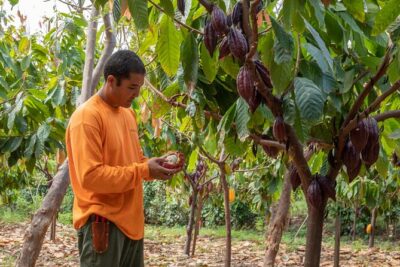
Maui Ku’ia Estate Guided Cacao Farm Tour and Tasting
Read our review →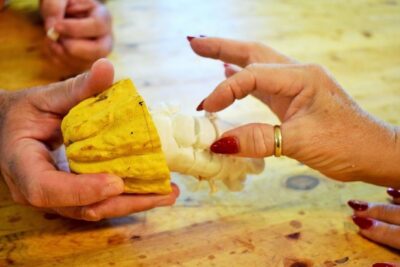
Award Winning Farm Tour: Coffee, Chocolate and Unique Gifts
Read our review →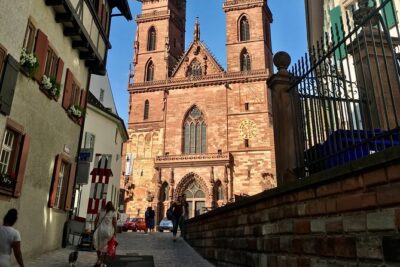
Basel Farmer’s Market, Cheese, Chocolate & Pastry Tour
Read our review →
Maui Ku’ia Estate Guided Cacao Farm Tour & Tasting
Read our review →
Craft Chocolate Tasting and Farm Experience on the Big Island
Read our review →Lists this farm appears in