
Reviewed · UK FARM TOURS
Makars Mushroom Farm Summerhall Tour with DIY Block Making
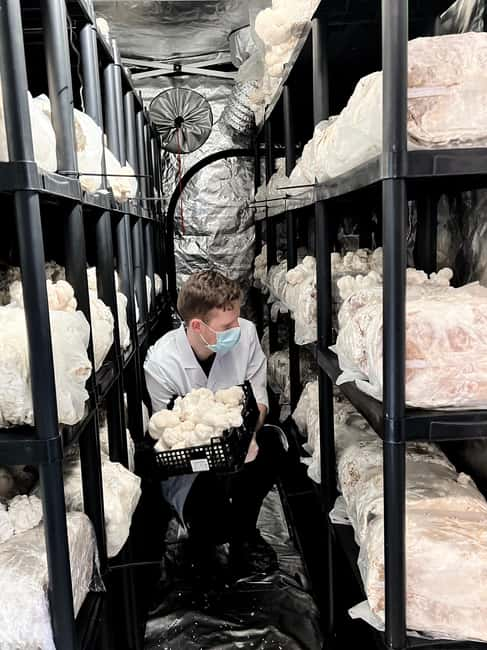
Makars Mushroom Farm grows Lion’s Mane mushrooms in a place you would never expect: a disused underground basement beneath Edinburgh’s Summerhall arts venue. In one brisk hour, you see how sterile grain becomes a fruiting crop, then make your own block to take home and watch develop over about three weeks.
I like two things here. First, the tour gives you a real look at working mushroom production, not just a talk beside a display case. Second, the hands-on DIY grow block turns a curious visit into a small home science project. The main drawback is the setting: the basement has no accessible access and may feel tight if you are claustrophobic.
Key points at a glance
- Underground farm: Follow signs through Summerhall to a disused basement and the farm’s machine room.
- Lion’s Mane focus: See grain production, incubation, sterile handling, and fruiting in action.
- Small English-speaking group: Numbers are limited to eight, so you have a fair chance to ask questions.
- Make your own block: Inoculate a mushroom block and take it home to fruit in roughly three weeks.
- Good value at $13: The practical activity and farm access make this more than a basic talk.
- Access matters: There are stairs to the basement, no wheelchair access, and children under 10 cannot join.
Why this small Edinburgh tour is worth your time
Mushrooms are easy to take for granted. You see them in a supermarket box, cook them in a pan, and rarely consider what happens before harvest. At Makars, you get a clear look at the controlled work behind an unusual crop.
The farm focuses on Lion’s Mane, a white mushroom with a shaggy, coral-like shape. The tour explains how it moves through several stages, beginning with grain production and continuing through incubation and fruiting. That progression gives the visit a useful structure. You are not simply shown a finished mushroom. You see the stages that make the finished mushroom possible.
The guide also places fungi in a wider biological context. Fungi are described as a separate branch in evolution, with possible food benefits that sit somewhere between the usual categories of meat and plants. You do not need a science background to follow the discussion. The tone is informal, practical, and suited to people who know little about cultivation.
At a 4.9 rating from 12 bookings, the experience has made a strong impression, but the real value is easier to measure in practical terms. For $13, you get a one-hour farm visit, a guided explanation of the growing process, a hands-on block-making session, and a project to continue at home. That is a good return for a short activity in central Edinburgh.
More Farm Tours in the world:
- Half-Day Thai Cooking Class at Organic Farm in Chiang Mai
★ 5.0 · 19,087 reviews - Florence Pizza or Pasta Class with Gelato Making at a Tuscan Farm
★ 5.0 · 6,801 reviews - Cooking Class and Lunch at a Tuscan Farmhouse with Local Market Tour from Florence
★ 5.0 · 4,831 reviews
Finding Makars beneath Summerhall
Summerhall is an arts venue near the Meadows, south of Edinburgh’s Old Town. The mushroom farm is not in a bright shopfront or a glasshouse. You enter through Summerhall’s main entrance, walk to the back door where the stairs are, and follow signs for the machine room.
Once downstairs, follow the signs to the end of the corridor and turn left. This is worth knowing before you arrive because the farm’s location is not obvious from the street. Give yourself a little time to find the route rather than arriving at the last second.
The underground setting is part of the character of the visit, but it also creates limits. There is no accessible access, and the stairs rule out wheelchair use. The basement may not suit anyone with claustrophobia. Children under 10 are not permitted, so this works better for older children, teenagers, and adults.
Summerhall is easy to reach without a car. You can walk through the Meadows, bring a bicycle inside, use the racks, or take a bus. Lothian routes 3, 5, 7, 8, 29, 31, 47, and 49 stop on South Clerk Street, a short walk away. Routes 42 and 67 stop outside the main entrance. Limited street meter parking is available, but I would not make driving your first choice.
Inside the sterile growing rooms
The first useful lesson is that mushroom farming is not as simple as adding water and waiting. Reliable production depends on clean conditions and careful control.
You learn how Makars produces grain and prepares it for mushroom growth. The guide explains the sterile techniques used to protect the developing culture from unwanted organisms. This part is especially useful because it shows why commercial mushroom growing needs more care than a casual home experiment.
The details are practical rather than overly technical. You learn why sterile conditions matter, how incubation fits into the process, and how the mushroom moves from a prepared substrate toward the fruiting stage. The farm’s setup gives you a chance to see the working environment instead of hearing only an abstract explanation.
For me, this is where the tour earns its keep. A standard food tour might tell you where a product comes from. Here, you see the controlled conditions that shape the product from the start. The lesson also explains why exotic mushrooms such as Lion’s Mane need a reliable method if they are to be grown again and again.
The group size helps. With no more than eight people, the guide can keep the talk conversational and respond to questions. You are not lost in a crowd or standing far from the action. The hour moves at a sensible pace, with enough explanation to interest a beginner without turning into a formal classroom.
Watching the fruiting tents
The fruiting tents are the most visual part of the visit. This is where the developing mushroom crop begins to form its recognizable growth. You learn what the farm monitors to keep the crop on track, including oxygen, water, and nutrients.
Those points matter because fruiting is not a passive final step. The crop needs the right conditions, and the guide explains what to watch as the mushrooms develop. You also discuss what a healthy crop should look like before harvest.
This is a good moment to ask questions. You might want to know how the farm spots a problem, when a mushroom is ready to pick, or how the conditions differ from those used during incubation. The provided format encourages questions, and the small group means you are not limited to listening from the back.
The fruiting tents also make the farm feel like a working place rather than a themed exhibit. You see the crop at a stage where small changes in care can affect the result. That connection between oxygen, moisture, nutrients, and harvest is one of the clearest lessons of the hour.
Do not expect a huge production site. The experience takes place in an underground basement, and the scale is compact. That is a benefit if you want a close look, but anyone expecting a large industrial facility should adjust expectations.
Same fields, a different sort of morning:
- Chiang Mai: Authentic Cooking Class with Market & Farm Visit
★ 4.9 · 4,546 reviews - Tromsø: Reindeer Camp and Sami Cultural Tour with Lunch
★ 4.7 · 3,326 reviews - Maui Pineapple Farm Tour in Haliimaile
★ 5.0 · 2,855 reviews - Sorrento Farm and Food Experience including Olive Oil, Limoncello, Wine tasting
★ 5.0 · 2,524 reviews
Making your own Lion’s Mane block
The tour ends with its most memorable feature: you inoculate your own mushroom block and take it home.
The practical session gives the visit a clear payoff. After seeing how the farm handles sterile growing conditions, you take part in a simplified version of the process yourself. You leave with something that can produce its own Lion’s Mane mushrooms in about three weeks.
That timing makes the activity easy to understand. You do not need to wait for an unknown season or care for the block for months before seeing results. The expected fruiting period is short enough to keep your interest, though growing conditions at home will still matter.
The home block also helps you remember the lesson. Instead of leaving with only photographs or a few new facts, you have a living project to monitor. You can watch for changes, think about moisture and placement, and connect what you see at home with what the guide explained in the fruiting tents.
This is particularly good for families with older children, couples, and anyone who enjoys practical activities. A parent and two sons aged 18 and 12 both enjoyed the visit, which gives you a useful sense of the age range. The under-10 rule remains in place, but older children can take part without needing to be mushroom experts.
The farm also shows time-lapse videos of mushrooms fruiting. These clips make the process easier to grasp because you see gradual growth compressed into a short sequence. They are a fun finish to the technical side of the tour and help you imagine what your own block may do at home.
The guide and the tone of the hour
The guide leads in English and keeps the session informal. You can expect a friendly, down-to-earth style rather than a stiff lecture. The experience has been especially praised for its engaging host and clear explanations.
That tone matters with a topic that could become technical very quickly. Sterility, incubation, grain, oxygen, and nutrients are not hard ideas, but a dry presentation would make them feel so. Here, the practical setting and question-led format keep the subject approachable.
The guide’s role is not only to explain what you are seeing. You are also encouraged to notice details, ask questions, and understand what comes before and after each stage. If you have an interest in food, small-scale farming, biology, or sustainability, you can ask more detailed questions. If you simply want an unusual activity in Edinburgh, you can enjoy the visual side and the home project without studying every term.
I would avoid booking this if you want a quiet, self-guided visit. The farm experience is built around explanation and interaction. It suits people who enjoy learning directly from a person and trying something with their hands.
Is $13 good value?
At $13 per person, this is one of the easier Edinburgh activities to recommend on price alone. The duration is only one hour, so it is not a full afternoon outing. Still, you receive several separate elements: access to the farm, a guided tour, an explanation of cultivation, a look at the fruiting tents, a take-home block, and time-lapse viewing.
The grow block is the key value point. Many short tours end when the guide says goodbye. Here, you leave with an activity that continues at home. It gives you a reason to keep thinking about the tour and lets you see if the process works in your own space.
There are limits to the value for some people. If you cannot use stairs, the visit is not suitable. If you dislike enclosed underground rooms, the setting may outweigh the low price. Also, the one-hour format gives you a focused introduction, not a long workshop or a full farming course.
Free cancellation up to 24 hours before the start and the option to reserve now and pay later make the booking less rigid. You should still check the available starting time before committing, as the activity runs for one hour and group places are limited.
Who should book this farm visit?
I would choose this for an unusual break from Edinburgh’s usual museums, monuments, and food stops. It is especially well suited to:
- People curious about fungi but new to cultivation
- Food-minded visitors who want to understand how a specialist crop is grown
- Families with children aged 10 or older
- Couples looking for a short, hands-on activity
- Visitors interested in small-scale production and growing at home
- Anyone who likes leaving an experience with something practical to care for
You do not need to be a mushroom enthusiast. The tour is designed for all interest levels, and the guide can explain the basics without assuming prior knowledge.
I would think twice if you have a strong fear of enclosed spaces, need step-free access, or want a large farm with many different mushroom varieties. The supplied information centers on Lion’s Mane, so you should book this for a focused look at that crop rather than a broad survey of every edible mushroom.
Practical tips before you go
Wear something comfortable for walking through the venue and going downstairs. The most important preparation is simply knowing the route: main entrance, back door with stairs, machine room signs, then left at the end of the corridor.
Arrive with questions. You may want to ask about sterile handling, how the farm controls oxygen and water, or what signs show that a crop is ready for harvest. The small group gives you a good chance to take part.
Plan a little space at home for the block you take away. The information says it should fruit in around three weeks, but you will need to follow the care instructions provided during the session. The point is not just to receive a souvenir. It is to watch a living process continue after you leave.
Public transport is the sensible option. Summerhall is walkable through the Meadows, and several bus routes serve the venue or nearby South Clerk Street. Parking exists on the street but is limited, so I would not count on finding a convenient meter space.
Should you book Makars Mushroom Farm?
Yes, if you want a short, affordable Edinburgh activity with a real hands-on finish. The farm’s underground setting, clear Lion’s Mane focus, small group size, and take-home block give it more substance than a simple talk.
Book it with the access limits in mind. The stairs and basement are not suitable for wheelchair users or anyone uncomfortable underground, and children must be at least 10. For everyone else, $13 buys an hour of useful instruction and a three-week mushroom project that keeps the experience going at home.
FAQ
How long does the Makars Mushroom Farm tour last?
The tour lasts one hour.
How much does the experience cost?
The listed price is $13 per person.
What type of mushrooms does Makars focus on?
The tour focuses on Lion’s Mane mushrooms, including grain production, incubation, and fruiting.
Can I make something during the tour?
Yes. You inoculate your own mushroom block and take it home.
When should my mushroom block begin to fruit?
The block should fruit in about three weeks.
Is the tour conducted in English?
Yes. The live tour guide leads the experience in English.
How many people can join the group?
The group is limited to eight participants.
Is the tour suitable for children?
Children under 10 are not permitted. The activity is suitable for older children, including those aged 10 and above.
Is the farm wheelchair accessible?
No. The farm is in an underground basement reached by stairs, and there is no accessible access.
Just added around the world
- Zanzibar: Walking Spice Farm with Local Cooking Class★ 4.4 · 9 reviews
- Zanzibar:Jozani forest, Spice farm with Swahili Cuisine clas★ 4.2 · 3 reviews
- ZANZIBAR, Stone town tour, Prison Island & Spice farm★ 5.0 · 11 reviews
- Zanzibar: Spice Farm Tour with Traditional Cooking Class★ 4.6 · 16 reviews
- Zanzibar: Stone Town City Tour and Spice Farm with Lunch★ 3.7 · 33 reviews
- Zanzibar: Spice farm tour with Zanzibar fruits tasting★ 3.8 · 7 reviews
- Zanzibar: Spice Farm Tour with Cooking lesson★ 4.5 · 4 reviews
- Zanzibar: Spice Farm Tour with Traditional Cooking Class★ 4.8 · 6 reviews
UK Farm Tours, compared.
Farm Attraction – Highland Cows, Animal Feeding, Wholesome fun!
Read our review →
Liverpool Music Icons Tour led by a member of 90s band The Farm
Read our review →
Guided Hebridean Farm Hike near Tobermory, Isle of Mull, Scotland
Read our review →

Liverpool: Music Icons Tour with 90s band ‘The Farm’
Read our review →
Private Downton Abbey Tour, including Bampton, Cogges Farm, and Highclere
Read our review →

Lists this farm appears in